 EN

How Do You Choose Bath Towel Sets Wholesale for Hotel Projects?
2026/11/19
A hotel buyer's guide to bath towel sets wholesale. Covers set composition, GSM tiers, GB/T 22800-2023 checks, colorfastness, shrinkage, and cost per use.
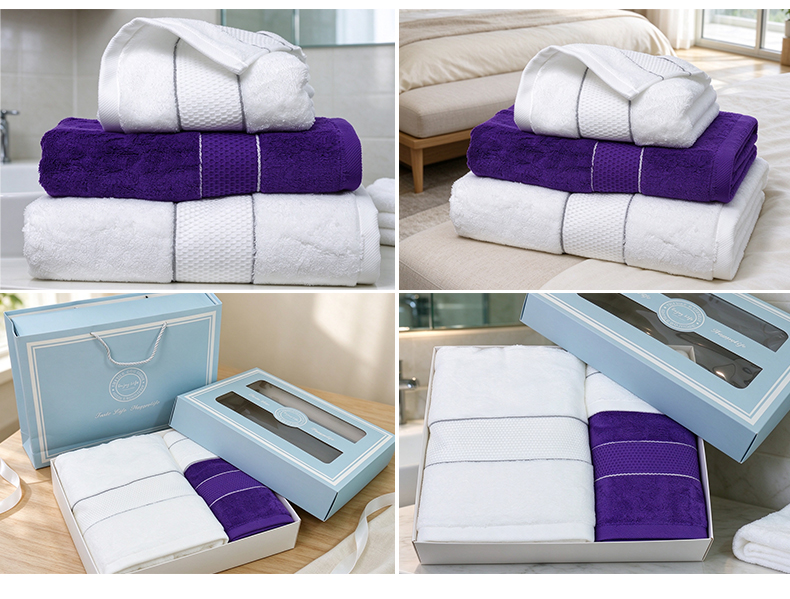
Controlling dimensional stability during mass production remains one of the greatest technical hurdles for any modern towel set factory striving to meet strict international retail standards. Cotton fibers naturally tend to swell, twist, and contract when subjected to moisture and heat, which frequently leads to unexpected dimensional changes after the first few industrial laundering cycles. To prevent end users from experiencing unacceptably tight or warped products, production facilities must manage yarn tension meticulously from the initial sizing stage down to final weaving and thermal finishing. A reliable production plant integrates continuous mechanical pre-shrinking and heat-setting treatments to relax the loop structure before sewing takes place. During a major hotel linen production run in an export processing hub, quality inspectors noticed that skipping a critical relaxed-drying phase caused finished items to shrink nearly eight percent after commercial washing, throwing off the exact specification requirements. Implementing strict tension controls during raw yarn preparation and weaving prevents these severe alterations and ensures uniform batch dimensions. A dependable towel set factory must also maintain precise environmental controls within the workshop to keep humidity fluctuations from affecting raw cotton elasticity prior to mechanical processing. Every modern towel set factory relies on these foundational steps to guarantee long-term product reliability and customer trust.
Before any dyeing or finishing occurs, raw cotton loops must undergo intensive scouring and desizing to eliminate natural waxes, pectins, and spinning oils that inhibit uniform water absorption. If these natural impurities are not completely stripped away, subsequent chemical treatments will penetrate unevenly, creating localized areas of high tension that trigger severe shrinkage and poor dye penetration. Modern textile facilities utilize continuous open-width washing ranges and controlled enzymatic baths to relax the cellulose structure thoroughly without damaging the staple fibers. Monitoring liquor ratios, bath temperatures, and chemical concentrations with automated sensors guarantees that every batch achieves a stable baseline before moving into reactive dye vats. Skipping or rushing this preparatory phase inevitably compromises the structural integrity of the fabric, leading to premature fiber distortion and customer complaints regarding sizing inconsistency. Operating a well-calibrated towel set factory means ensuring that every pre-treatment vat undergoes rigorous daily testing to maintain optimal alkalinity levels and uniform chemical distribution across all manufactured lots.
Achieving exceptional colourfastness requires more than simply applying high-grade pigments; it demands precise chemical bonding between the dye molecules and the cellulose polymer chains of the cotton loops. Reactive dyes form covalent bonds that offer superior resistance against fading caused by frequent washing, sunlight exposure, and harsh commercial laundering detergents. However, if fixation temperatures and alkali concentrations fluctuate during the fixing phase, unreacted dye particles remain trapped on the surface, resulting in severe crocking and bleeding issues. A reputable production line relies on automated spectrophotometers and closed-loop computer-controlled steaming chambers to lock in color molecules uniformly across every single batch. Laboratory testing in accordance with ISO standards helps verify that the dyed fabric withstands wet and dry rubbing tests without transferring excess pigment onto other surfaces. Any leading towel set factory invests heavily in advanced dyeing technology to ensure that high-volume orders maintain consistent color vibrancy over prolonged usage cycles.
| Testing Parameter | Industry Standard Benchmark | Risk of Poor Control |
| Dimensional Shrinkage | Maximum 3% to 4% after washing | Misshapen products, customer dissatisfaction |
| Wet Rubbing Fastness | Rating 4 to 5 on grey scale | Color transfer onto skin and clothing |
| Washing Fastness | Minimal color change at 60 degrees Celsius | Premature fading and dull appearance |
Even the finest reactive dyes will fail to deliver lasting stability if residual alkalis and unfixed dye molecules are left lingering within the dense pile of the fabric after fixation. The soap washing and neutralization stages act as the final chemical defense line, stripping away loose surface colorants that would otherwise cause bleeding during the consumer's first home wash. Industrial washing ranges must maintain specific cascading water temperatures and optimal pH levels to ensure complete extraction of harmful chemical residues. Failing to purge these residual elements completely not only ruins the colourfastness ratings but also alters the natural pH of the cotton, causing skin irritation and fabric degradation over time. Quality control technicians pull random samples at the end of the wet-processing line to verify chemical neutrality before the material advances to the mechanical finishing floor. A professional towel set factory enforces strict protocols during this stage to protect both end-consumer safety and environmental compliance standards.
The final phase of production involves specialized mechanical drying and thermal setting processes that lock the physical dimensions and color vibrancy into place permanently. Tenter framing machines stretch and stabilize the fabric width under controlled heat and tension, effectively neutralizing any remaining elastic memory within the cotton yarns. Operators must monitor the overfeed percentage carefully to ensure the loops remain open and fluffy, providing that signature plush hand feel expected by hospitality buyers. Mofisi enforces rigorous temperature and tension monitoring across all finishing lines to guarantee exceptional dimensional stability and enduring colourfastness for bulk international textile buyers. Proper mechanical finishing ensures that every manufactured batch maintains its structural geometry and aesthetic appeal throughout its entire operational lifecycle. Maintaining these rigorous standards is what sets an elite towel set factory apart in today's competitive global marketplace.
2026/11/19
A hotel buyer's guide to bath towel sets wholesale. Covers set composition, GSM tiers, GB/T 22800-2023 checks, colorfastness, shrinkage, and cost per use.
2026/11/19
Build a reliable hotel towel wholesale supply chain. Covers GB/T 22800-2023, verification protocols, contracts, and wash-cycle validation.
2026/11/19
Six common mistakes in hotel towels wholesale procurement. Covers cost-per-use, GSM verification, wash testing, sample sealing, colorfastness, and contract terms.
2026/11/19
Guide to certifications for hotel towels wholesale. Covers OEKO-TEX, GOTS, OCS, BSCI, SMETA, ISO standards, and regional compliance requirements.
2026/11/19
Guide to bath towel sets wholesale for hotels. Covers GSM, cotton grades, yarn count, loop height, and supplier wash-test verification.
2026/11/19
Learn how to specify stitch density for custom embroidered bathrobes. This guide covers SPI, stabilizers, and digitizing to prevent fabric stiffness in hotel robes.
